Forgotten Female Bodies III: Views from Enactivism and Evo-Devo

We are happy to announce the Third Forgotten Female Bodies Workshop: Views from Enactivism and Evo-Devo. This international meeting will bring together scholars from different disciplines to explore how feminist perspectives intersect with philosophy of biology, cognitive science, and embodied approaches.

One-Day workshop

Donostia, 26 September 2025
Batzar Aretoa – Sala de Juntas (HEFA I)

Speakers:

Anna Ciaunica (Univ. Lisbon)
Enara García (Univ. Southern Denmark)
Laura Mojica (EHU)
Laura Nuño de la Rosa (UCM)
Mihaela Pavlicev (Univ. Vienna)

Organizers:

IAS Research Group for Life, Mind and Society
Alejandra Martínez-Quintero, David Cortés-García & Arantza Etxeberria

Program:

10:30-10:45Welcome coffee & Reception
10:45 – 11:00Arantza Etxeberria & Alejandra Martínez-QuinteroShort welcoming address
11:00 – 11:45Laura Nuño de la Rosa
Chair: Arantza Etxeberria 
Is Sex a character? Modularising sexual differences
11:45 – 12:30Anna Ciaunica
Chair: Ezequiel Di Paolo
The Forgotten Body: The Emergence of Conscious Experiences in Early Life
12:30 – 12:45Short Break
12:45 – 13:30Laura Mojica
Chair: Ezequiel Di Paolo
Implicated Recognition and the Grounding of Normativity
13:30-15:00Lunch break
15:00 – 15:45Mihaela Pavlicev
Chair: Alejandra Martínez-Quintero
Integrity of eutherian feto-maternal interface
15:45-16:30Enara García
Chair:
The Path-Dependent Mind: Individuation, Vulnerability, and the Ontogenesis of Mental Conditions
16:30- 17:00Final thoughts and open debate
Chair: David Cortés-García

Abstracts

Laura Nuño de la Rosa: Is Sex a character? Modularising sexual differences

Debates about the concept of sex often stall because sex is treated as a property of individuals rather than of characters. I challenge such definitions and instead propose analyzing how sexual characters are individuated in evolutionary biology. Using pregnancy and female orgasm as case studies, I compare selectionist and evo-devo criteria, highlighting their strengths and limits. Viewing sex as an attribute of developmentally individuated characters explains why sexual traits are only loosely correlated, enables explanatory generalizations across species, accommodates continuous variation, and provides a coherent framework for intersex and hermaphroditic individuals.

Anna Ciaunica: The Forgotten Body: The Emergence of Conscious Experiences in Early Life

The search for the neural correlates of consciousness has been influential in the past decades. Yet, tackling the fascinating question of the emergence of early subjective experiences through an individualistic, adult-biased, and neuro-centric lens may be misleading. The key idea is that developmentally speaking, one must first examine how cells (and not just neurons) operate in tandem to sustain the self-organisation of the human organism as a whole.  Here I argue that the hard problem of consciousness cannot be addressed without putting the forgotten body back into the picture. This includes the necessary presence of the other body (i.e. the pregnant person) too, without which the fascinating journey of conscious life wouldn’t be possible tout court. 

Laura Mojica: Implicated Recognition and the Grounding of Normativity

A central challenge in explaining cognition is showing how normativity is grounded beyond individuals’ self-individuation and immediate interactions. A common strategy appeals to social practices, but it remains unclear how they ground normativity. Without such an account, references to practices risk circularity in grounding meaning, skill, and value. I argue that recognition provides the solution, not only as rational attribution or shared intelligibility, but also as an implicated, dialectical interaction in which self and other are sustained and transformed. Drawing on enactive epistemology, I situate recognition within a virtual field where even fleeting encounters presuppose the other’s potential for deeper, transformative interaction. 

Mihaela Pavlicev: Integrity of eutherian feto-maternal interface

Eutherian pregnancy is an intriguing phenomenon, as its evolutionary origin required circumventing a number of biological “rules” otherwise considered necessary to maintain the integrity of an organism. These novel “circumventions”  entail attachment and breaching of the epithelium with inflammation, yet without rejection by the innate immune system, maintaining an open wound over prolonged period of time, and overcoming of the allograft rejection. I will talk about a novel way to think about one of these novelties, namely the ability of maternal and fetal cells to organize into a common tissue unit.

Enara García: The Path-Dependent Mind: Individuation, Vulnerability, and the Ontogenesis of Mental Conditions

The enactive approach to mental conditions offers an alternative to neurocentric, static models, adopting a processual and relational ontology of mind and its disorders. Proposed as a framework for individualized dynamic network models, it highlights tensions with network theories that emphasize synchronic explanations (causal, mechanistic, topological). Instead, enactivism advocates an ontogenetic explanation, viewing conditions as entwined with developmental individuation. This paper proposes integrating ontogenetic explanations into network models through propensity-based accounts. Incorporating developmental processes fosters dynamic, preventive, and vulnerability-based paradigms in psychiatry, aligning with the principles of neurodiversity and “forgotten minds”.

[CLOSED] PhD Studentship opportunity on Theory and Philosophy of Agency with us!

If you want to do a PhD with us within the Outagencies project, we have just opened a PhD studentship grant application for a 4-year scholarship. Here is some relevant information:

SUMMARY: Opportunity to join us at the IAS-Research Center for Life, Mind, and Society [https://ias-research.net] at the University of the Basque Country (San Sebastián) for a PhD studentship within the “Outagencies: Varieties of autonomous agency across living, humanimal, and technical systems” project [https://outonomy.net/project-description/]: an interdisciplinary exploration of agency across philosophy, biology, AI, and social sciences. We welcome passionate candidates from any background aligned with our research themes, who bring strong motivation, English proficiency, and a robust academic profile.
Deadline: November 18th, 2024
Pre-submission here: https://forms.gle/AGAHu6osrSUJ4Bxd9
Official submission here: https://www.ehu.eus/es/web/ikerketaren-kudeaketa/-/fpi-2024_upv_ehu
Salary: €19,500-€25,000 annually during 4 years (salary increases every year)
Duration: 4 years starting early 2025
More updated information: https://outonomy.net/?p=335

New (6-month) post-doc position

A new position is open for a 6-month full-time post-doc contract at IAS-Research.

Deadine for application: June 11th (2021).

The contract will extend from July 1st to December 31st (2021).

Among other documents, the interested candidates should present:

  1. PhD title
  2. Updated CV
  3. Motivation letter (max. 2p.)
  4. Language titles (English & Basque) — if you have any.

More details on the application procedure (please, read carefully and follow the instructions):

https://www.ehu.eus/es/web/iip/-/conv_pers_invest_01_06_2021

In additon, please, let us know that you are applying through an e-mail message to kepa.ruiz-mirazo@ehu.eus, including the CV and the motivation letter presented.

PhD Scolarship 2020-2024: expression of interest is now OPEN

We have been awarded a scholarship for a PhD student to develop her/his PhD with us on the topics of the research project entitled “OUTONOMY: fleshing out autonomy beyond the individual”. We are searching for a dedicated, smart, philosophically minded, technically skilled and collaborative person willing to start a research career with us. Deadline to submit your expression of interest is October 10th!

It is an FPI doctoral scholarship for Research project OUTONOMY, at IAS-Research Center for Life, Mind, and Society, UPV/EHU (University of the Basque Country). It would cover a 4 year salary to complete a PhD thesis on the contents of the project starting late 2020. You can know more about the research project OUTONOMY on our blog post, or by reading the project description document.

If you are interested on this scholarship, please follow the link bellow:

Please help us sharing and promoting this scholarship call. Many brilliant and enthusiastic students are searching for funding opportunities, we are searching for brilliant and ethusiastic students.

IMPORTANT NOTE: This is not the final nor the official call or application, but an expression of interest. The final form will be announced to all selected participants in this pre-call, open to anyone (independently of this expression of interes), and officially managed by the Spanish Ministry of Science and Innovation. The official call will be open sometime between mid October and November (you can check here last years call to be ready for the paperwork). The goal of this form is to encourage students to move forward towards the final application and for us to know some of the candidates in advance. It is highly recommended that you fill this form if you are planning to submit for the official application (which is run in a less friendly and massive procedure within the public administration). We want to know you better first.

OUTONOMY project: Fleshing out autonomy beyond the individual

We are happy to announce that the Outonomy (“Fleshing out autonomy beyond the individual”) project got officially funded by the Spanish Ministry of Science and Innovation. The project is co-lead by Leonardo Bich and Xabier E. Barandiaran.

As part of this project we got awarded with a PhD Scholarship. Please help us find and match the best candidates by sharing this link to our pre-application call: https://www.ias-research.net/?p=4525

Project summary and main research lines

The project aims to expand theories of autonomy beyond classical conceptions of the individual by including integrative, relational, collective and environmental dimensions into it.

The concept of autonomy, understood as the capacity of a system to set up and follow the norms of its own functioning, is of central relevance to contemporary science and society. Recently, the increasing acknowledgement of the deep interconnectedness, mutual dependence and multi-scale embeddedness of several natural and social phenomena, has directly challenged the very idea of autonomy, together with those of individuality and identity, and the possibility of its applications to scientific and social challenges.Building on top of 25 years of philosophical and trans-disciplinary research at the IAS-Research Center for Life, Mind and Society of the University of the Basque Country (UPV/EHU), centred on a naturalized theory of autonomy in biological and cognitive sciences, this project aims to expand theories of autonomy beyond classical conceptions of the individual by including integrative, relational, collective and environmental dimensions into it.

To do so the project pursues 4 main goals:

1- To develop an account of integration in autonomous systems, as an organizational principle to understand how ‘physiological’ cohesiveness emerges within and across systems.

2- To understand how inter-actions between autonomous systems can give rise to supra-individual or collective forms of autonomy and how these can alter the autonomy of the former.

3- To investigate the extension of autonomous systems into their environment (from prebiotic scaffolds to technology) to achieve viability and coordinate regulatory self-governing processes.

4- To address the issue of sustainability (at different scales) of new eco and socio-ecological systems emerging from previously independent autonomous systems.

In order to achieve these trans-disciplinary goals, the methodology involves naturalist conceptual analysis and synthesis based on an active dialogue with empirical research, computational and mathematical models and scientific theories. The profiles of the 5 research team members in philosophy of science, philosophy of biology and complex systems is complemented by an international work team of 24 collaborators including social scientists, computer modellers, network and data analysts, biologists and environmental scientists.

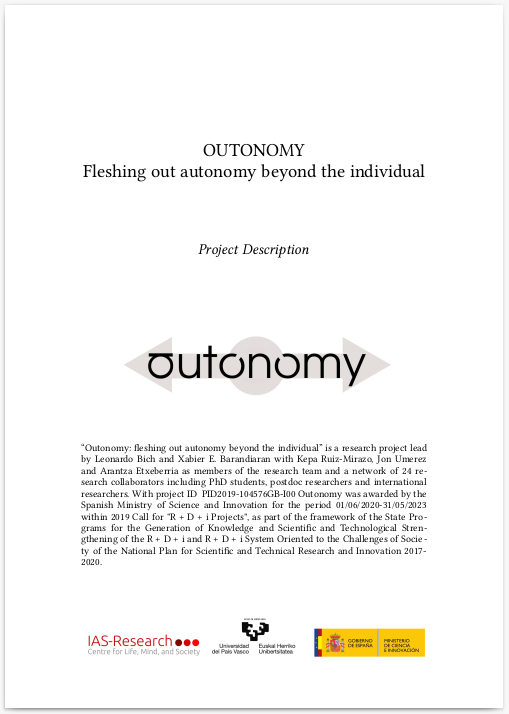
If you want to know more about the project, we recommend you read and download our project description document by clicking on the image below:

You can follow the project updates on ResearchGate at the following link: https://www.researchgate.net/project/OUTONOMY-Fleshing-Out-Autonomy-Beyond-the-Individual

Research Workshop Philosophy of Biology and Cognitive Sciences

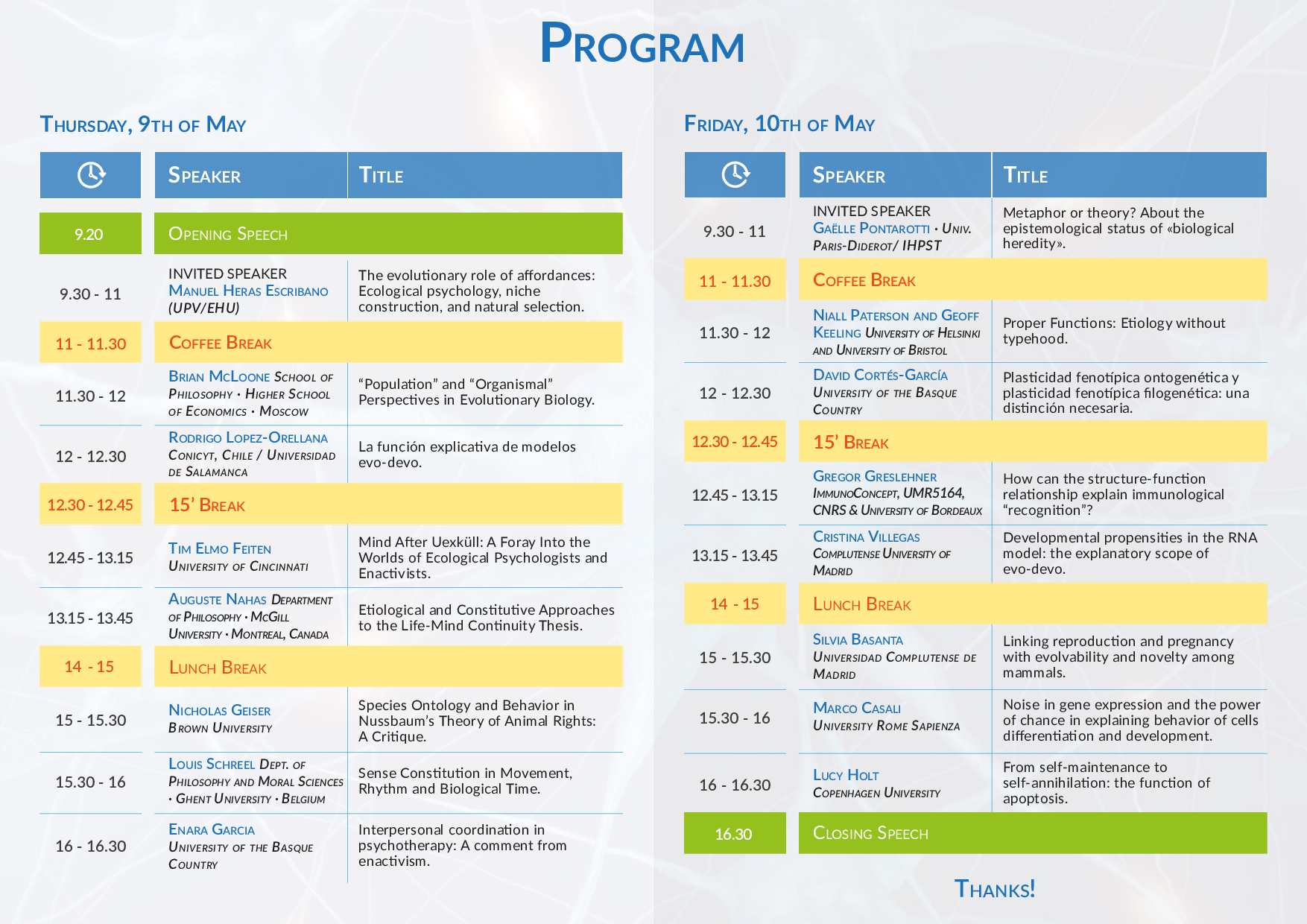
Since its origins in 2011, the Research Workshop on Philosophy of Biology and Cognitive Science (PBCS) is an annual encounter of young scholars that aims at bringing together researchers from different disciplinary backgrounds: philosophers, cognitive scientists, and biologists working on issues of common interest. In this workshop, young researchers can present their ideas and participate in the discussions, as well as attend the conferences of keynote speakers. Its main purposes are to serve as a tool for enhancing research through discussion and to promote the interdisciplinary of the ideas presented. In its ninth edition, the organizers would like to keep encouraging young researchers to participate in this fresh and distinctive forum.

DATE:

9 & 10 May

VENUE:

Sala de Grados. Faculty of Education, Philosophy and Antropology (EFA).

Avda, Tolosa 70. 20018 (San Sebastian)

KEYNOTE SPEAKERS:

Manuel Heras Escribano (UPV/EHU)

Gaëlle Pontarotti (Université Paris-Diderot)

PROGRAM:

WEBSITE:

https://pbcs9workshop.wixsite.com/pbcs9workshop/

Open call for a PhD position on ‘minimal metabolism’ (European Innovative Training Network)

Open call for a PhD position on ‘minimal metabolism’

[DEADLINE TO APPLY: extended to Feb 15, 2019]

A. Under the supervision of Kepa Ruiz-Mirazo – University of the Basque Country (Spain)

[Co-supervision: Christoph Flamm – University of Vienna (Austria)]

B. Within the European (Marie Curie) ITN Project ‘ProtoMet’

[Protometabolic pathways: exploring the chemical roots of systems biology]

NOTE: This project has received funding from the European Union’s Horizon 2020 research and  innovation programme under the Marie Skłodowska-Curie grant agreement No 813873.

C. Great opportunity for Early Stage Researchers (‘ESR’s – see below) highly motivated to investigate a deep scientific question, the origins of metabolism, working across several disciplines (physics, chemistry, biology, computer science, philosophy of science) but accurately and methodically, in close collaboration with other colleagues from academia and industry.

D. Training includes internships, secondments and a variety of technical courses/modules.

E. Transversal and transferable capacities to be developed: communication and team-work skills, among others.

F. Funding guaranteed for 36 months (salary & research support).


Requirements

All candidates must possess a Master’s degree or equivalent by the deadline for application (alternatively, a total of 240 ECTS — combining the B.Sc. and/or M.Sc. degrees), which allow them to enter a Spanish PhD program in Sciences or Humanities at the University of the Basque Country (UPV/EHU).

The applicant must be proficient in English, both written and spoken. Computer skills will also be valued (good command of python and C++, in particular).

Eligibility according to the Marie Curie Training Program

  • Researcher status: Early-Stage Researchers (ESRs) are young researchers who, at the date of recruitment (the starting date indicated in the contract), are in the first four years (fulltime equivalent research experience) of their research careers and have not been awarded a doctoral degree.
  • Nationality: Applicant ESRs can be of any nationality.
  • Mobility requirements: Applicant ESRs must not have lived or carried out their main activity (work, studies, etc.) in the country of the recruiting beneficiary (University of the Basque Country) for more than 12 months in the 3 years immediately prior to the date of recruitment (compulsory national service, short stays or holidays, and time spent as part of a procedure for obtaining refugee status under the Geneva Convention will not be taken into account).


Procedure

Interested applicants should contact Kepa Ruiz-Mirazo by e-mail (kepa.ruiz-mirazo@ehu.eus), before February 15 (2019), and provide him with the following documents/information:

  • A detailed CV
  • A copy of the Bachelor’s and Master’s certificates and the respective Transcript of Records
  • Summary of the Master’s degree thesis
  • A letter of motivation, including a declaration of whether s/he is applying to some other ESR in the ProtoMet network and, in that case, in which order of preference.
  • Email contact of two names of referees to be contacted for recommendation letter


More info

For some additional information, you can download the following pdf.


Fundamentals of IAS-Research Seminars

On March 6th we begin with a series of 6 bi-weekly seminars on the core lines of research of our group. The seminars are oriented towards PhD students but are open. If interested, please, get in touch with Ezequiel Di Paolo or Kepa Ruiz-Mirazo.

Information about topics, schedule, and readings following this link.

Location: Centro Santamaría, Sala de seminarios del grupo IAS (B14)

Time: 15:00 – 17:00


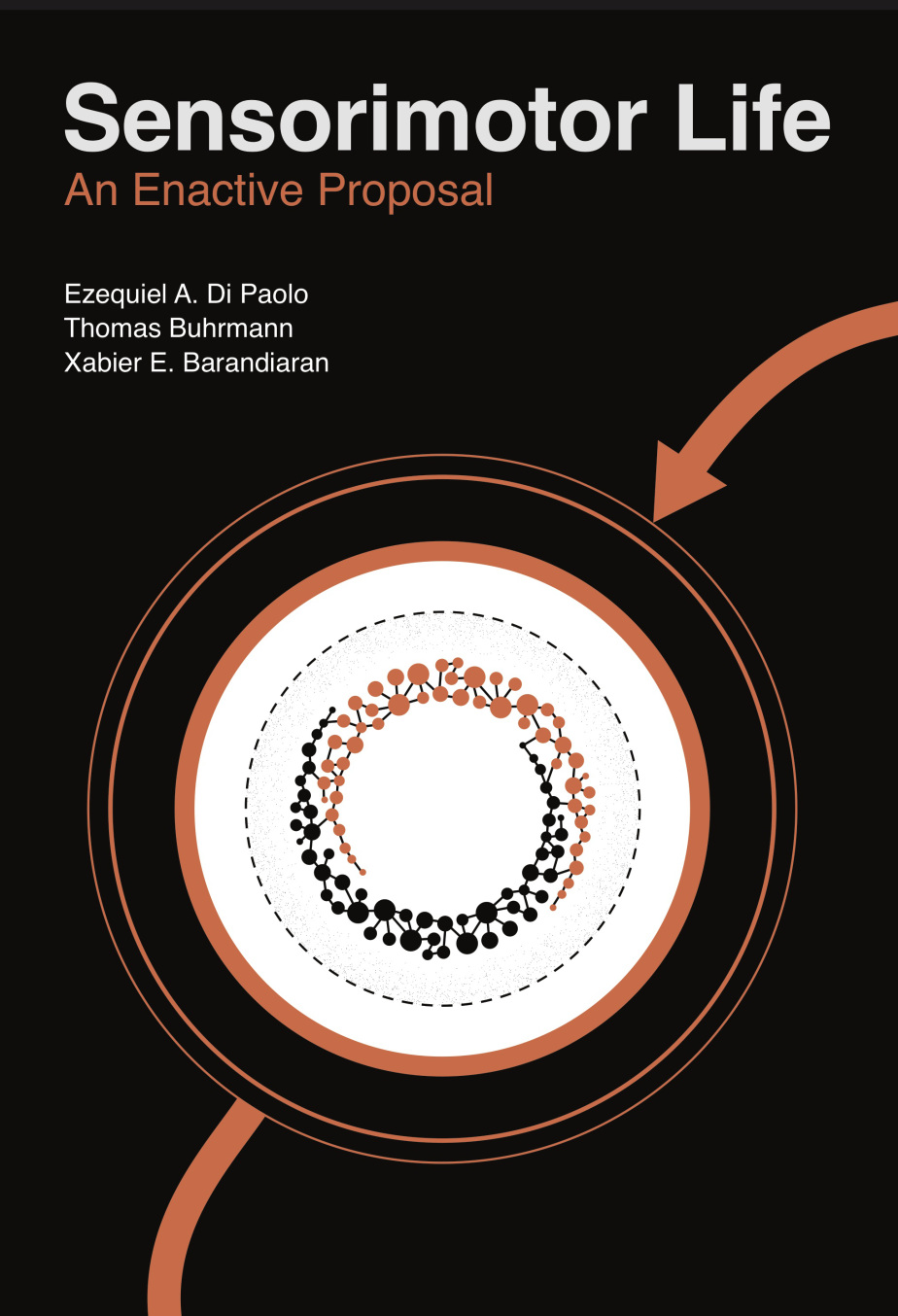
Sensorimotor Life: An Enactive Proposal, OUP 2017

Sensorimotor Life: An Enactive Proposal

By Ezequiel A. Di Paolo, Thomas Buhrmann, Xabier E. Barandiaran, 2017, Oxford University Press.

How accurate is the picture of the human mind that has emerged from studies in neuroscience, psychology, and cognitive science? Anybody with an interest in how minds work – how we learn about the world and how we remember people and events – may feel dissatisfied with the answers contemporary science has to offer.

Sensorimotor Life draws on current theoretical developments in the enactive approach to life and mind. It examines and expands the premises of the sciences of the human mind, while developing an alternative picture closer to people’s daily experiences. Enactive ideas are applied and extended, providing a theoretically rich, naturalistic account of meaning and agency. The book includes a dynamical systems description of different types of sensorimotor regularities or sensorimotor contingencies; a dynamical interpretation of Piaget’s theory of equilibration to ground the concept of sensorimotor mastery; and a theory of agency as organized networks of sensorimotor schemes, as well as its implications for embodied subjectivity.

Written for students and researchers of cognitive science, the authors offer a fuller view of the mind, a view better attuned to the experiences of people who live, work, love, struggle, and age, thrown into a world of meaningful relations they help create. Additionally, the book is of interest to neuroscientists, psychiatrists, and philosophers of science.